
A living operational view of the world
A living operational view of the world, rendered in context.
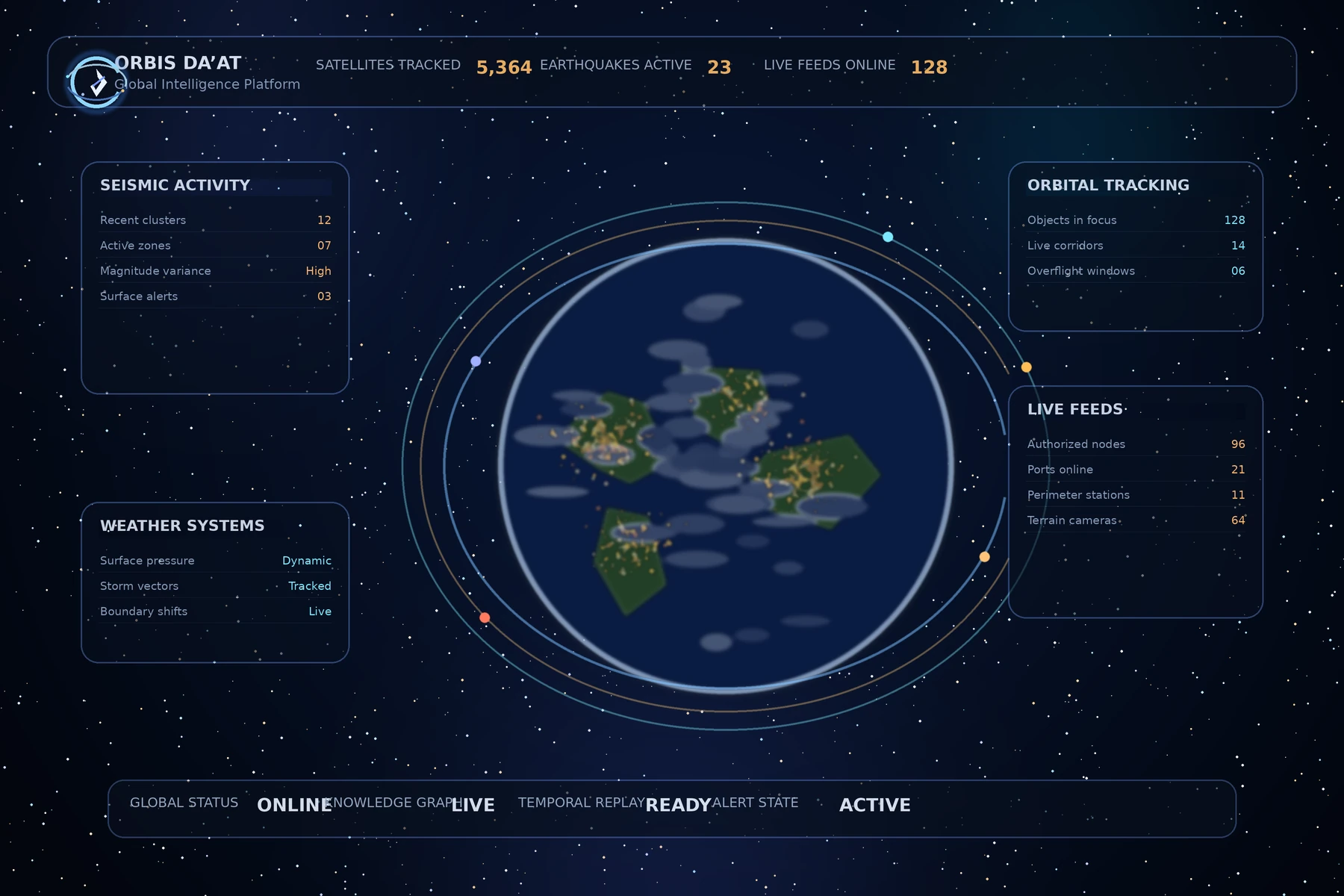
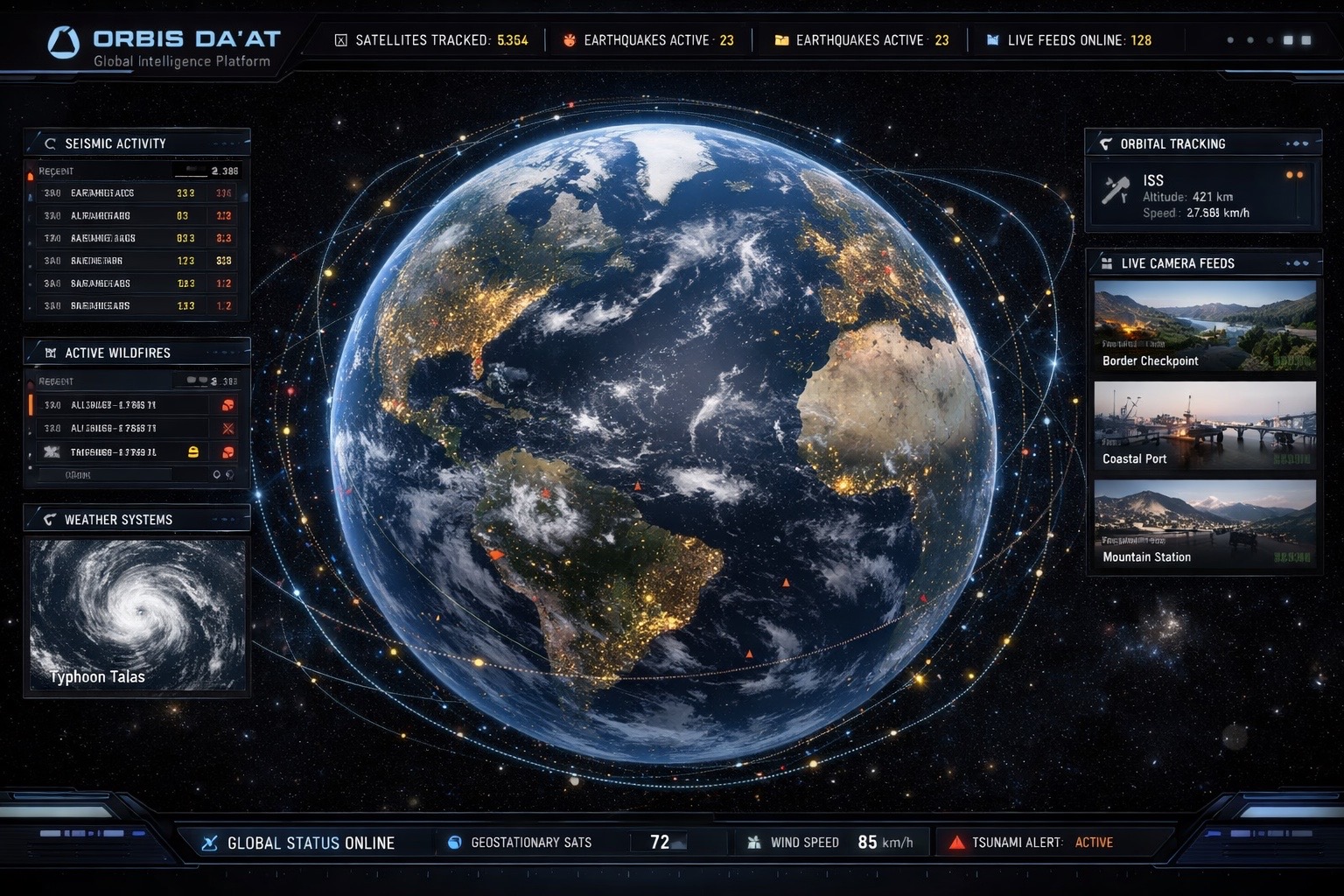
Orbis Da’at is a real-time planetary geospatial interactive intelligence platform: a living operational view of the world presented through a fluid, immersive globe and map interface. It gathers immense streams of information from across the earth, organizes them into a unified structure, and renders them spatially and temporally so users can perceive not merely isolated facts, but movement, pattern, causality, anomaly, and emerging events as they unfold.
Built for strategic intelligence, aerospace and maritime awareness, critical infrastructure visibility, investigative workflow, incident response, and mission-critical analysis.
Live multi-stream ingestion
Temporal replay + graph analysis
Overview
Geography, time, relation, event, identity, and consequence woven into one living interface.
Orbis Da’at transforms immense streams of data into one spatially and temporally unified operational reality. Users can move from a planetary perspective down to local terrain, rotate viewpoint, isolate regions, filter categories of activity, layer intelligence streams, and move backward or forward through time without losing continuity, provenance, or analytical rigor.
What it is
A living operational view of the world.
Orbis Da’at is a real-time planetary geospatial interactive intelligence platform presented through a fluid globe and map interface. It is designed to feel less like ordinary software and more like an active cognitive environment where the world becomes legible.
How it works
Massive information streams become one operational reality.
Satellite imagery, transponders, sensor networks, live telemetry, open-source reporting, logistics systems, environmental feeds, communications metadata, structured databases, and unstructured text are harmonized into a common ontology so data is linked, contextualized, and continuously usable.
Why it matters
Pattern, causality, anomaly, and consequence emerge in context.
The platform allows users to perceive not merely isolated facts but movement, relation, historical formation, and emerging events as they unfold. It reduces fragmentation and compresses enormous complexity into operational understanding.
Engine
Continuous ingestion architecture harmonizes the world into one common operational reality.
The platform can receive satellite imagery, aircraft and maritime transponders, sensor networks, live telemetry, open-source reporting, communications metadata, logistics systems, environmental feeds, infrastructure signals, incident reporting, imagery collections, structured databases, and unstructured text. Once normalized into a coherent ontology, that intelligence becomes linked, contextualized, and continuously usable rather than trapped in source silos.
Ingest
Receive many different classes of information at once, from imagery collections and telemetry to reporting, logistics, and infrastructure signals.
Normalize
Harmonize those inputs into a coherent ontology so people, organizations, vehicles, devices, facilities, routes, locations, documents, and events inhabit one common language.
Resolve
Fuse references from different systems into enduring operational identities with provenance, confidence, state, and historical continuity.
Correlate
Connect geography, time, relation, behavior, and surrounding context so hidden association and emerging significance can surface early.
Render
Project the intelligence picture onto an immersive globe or map where movement, risk, sequence, and network meaning remain visible in context.
Operate
Support investigation, alerting, collaboration, and decision-making from within the same living operational environment.
Knowledge graph
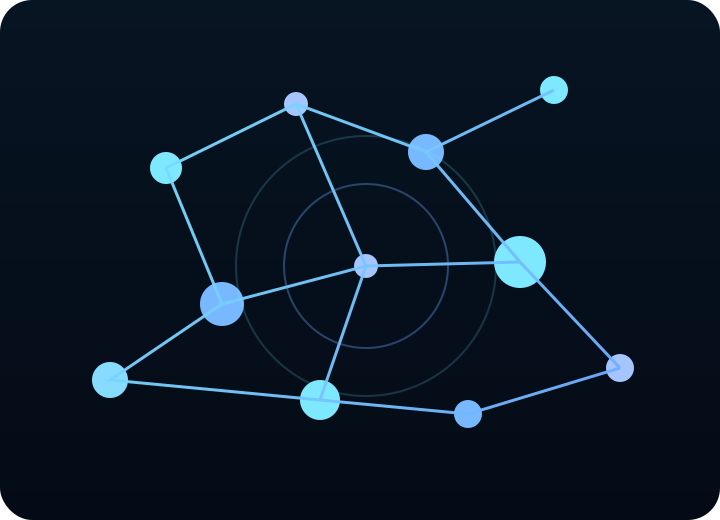
The globe is the surface. The hidden architecture of relation lives beneath it.
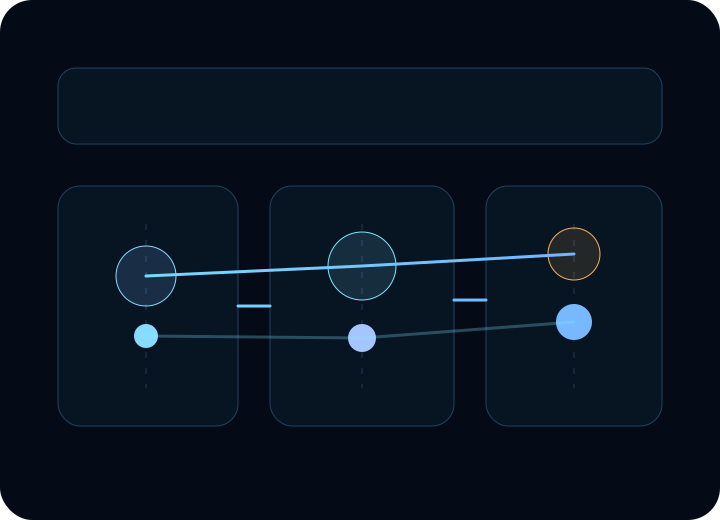
Beneath the visual interface is a live knowledge graph of entities and connections that can expose hidden associations between actors, assets, locations, transactions, communications, and events. Users can begin with a single vessel, aircraft, person, company, site, or incident and expand outward into ownership structures, historical movement, linked identities, logistical routes, recurring co-location patterns, associated records, supporting documents, and adjacent anomalies.
Geospatial
Move from a planetary vantage to local terrain while preserving context, source continuity, and mission relevance.
Relational
A live knowledge graph exposes how actors, assets, locations, transactions, communications, and events actually interlock.
Operational
Rules, thresholds, geofences, watchlists, and mission priorities transform detections into structured action.
Persistent
Objects and actors become enduring records with identities, histories, attributes, confidence levels, and changing states.
Temporal
The present can be monitored while prior movements, relationships, and sequences are replayed with precision.
Predictive
Models can score anomalies, surface weak signals, and render evolving risk directly onto the operational surface.
Real-time correlation
Incoming events are processed, correlated, and elevated at the speed of the event itself.
A detection in one stream can immediately awaken context from many others. A new signal on one side of the world can illuminate nearby assets, historical behaviors, prior incidents, associated entities, relevant documents, and probable implications within moments. Alerts are not merely notifications: they can become operational triggers tied to rules, thresholds, geofences, watchlists, behavioral models, and mission priorities.
Operational surface
Significance begins to emerge at operational speed.
Live correlation
Context enrichment
Operational triggers
Persistent entity resolution
Objects and actors are treated as enduring records, not temporary dots.
Vessels, aircraft, vehicles, facilities, network nodes, devices, organizations, and individuals can accumulate living operational profiles: where they have been, what they connect to, what sources support their identity, which behaviors they normally exhibit, and whether present activity aligns with expected patterns or suggests deviation.
Strategic intelligence
Reveal hidden association, evolving behavior, and mission-relevant activity across regions, actors, assets, and networks.
Maritime and aerospace monitoring
Track shipping corridors, overflight behavior, orbital context, patterns of presence, and route deviation in real time.
Critical infrastructure awareness
Observe facilities, routes, dependencies, environmental conditions, and surrounding anomalies as one living system.
Incident and disruption response
Correlate terrain, weather, reporting, infrastructure, and operational assets while events are still taking shape.
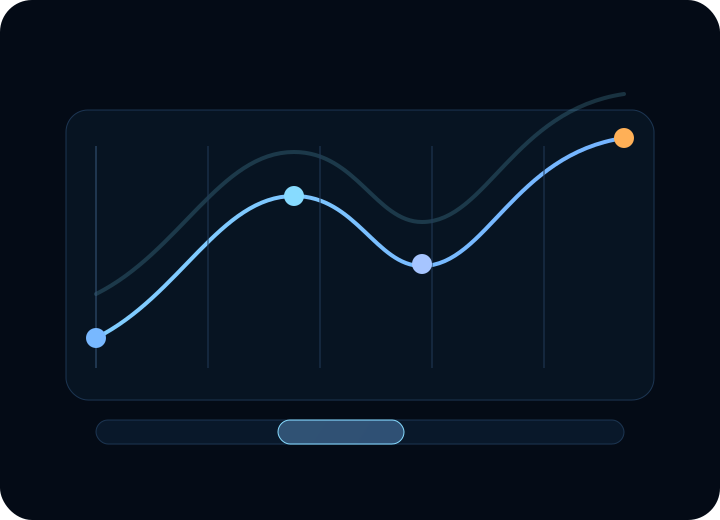
Temporal replay
Live monitoring and historical replay operate inside the same reality model.
Orbis Da’at is not bound to the immediate present. It functions as a replayable model of reality, allowing teams to reconstruct developments across hours, days, weeks, and longer arcs of time. Movements can be replayed, relationships can be seen as they formed, patterns can be compared across periods, and sequences of events can be reconstructed with precision.
This union of live monitoring and historical replay gives the platform both operational force and investigative depth. Teams can observe what is happening now while also asking how it emerged, what preceded it, what changed, and which signals were present before the situation became visible.
Predictive analytics
Advanced analytics and machine learning move the platform from observation into anticipation.
When advanced analytics and machine learning are integrated into the platform, historical behavior can inform forecasts about disruption, route deviation, clustering, escalation, instability, coordination, and emerging risk. Models can score anomalies, detect hidden patterns, surface weak signals, and identify events that merit attention before they become obvious.
These predictive layers can be rendered directly onto the globe as dynamic overlays, evolving risk surfaces, likelihood fields, pattern breaks, and scenario simulations, revealing where pressure is building, where change is beginning, and where attention should move next.
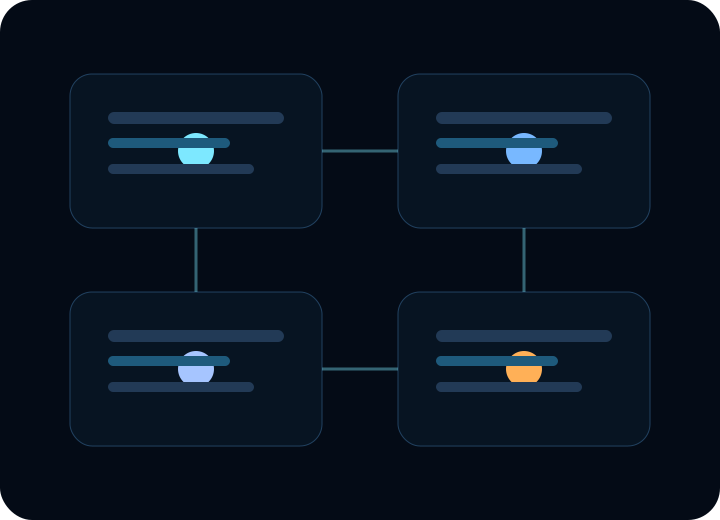
Collaboration
Analysts, operators, and decision-makers can work from the same living picture.
Maps, documents, records, imagery, timelines, field reporting, linked media, workflow states, and investigative chains can remain attached to the same analytical surface. Teams can annotate locations, share layers, compare interpretations, assign tasks, attach supporting material, and coordinate action without fragmenting context or losing analytic lineage.
Shared spatial awareness
Geographic, logistical, technical, strategic, and investigative understanding converge inside one interface.
Permissions govern who sees what. Workflows preserve accountability. Source context remains attached to every observation. The result is a collaborative intelligence environment built for precision, speed, continuity, and consequence.
Saved operational views and hypotheses
Attached notes, media, documents, and field reporting
Layer sharing, tasking, and coordinated action
Controlled access with analytic lineage and accountability
Platform access
The public site frames the intelligence environment. The secure platform is where authenticated teams enter the living operational surface itself.
Orbis Da’at is built to make geography, time, relation, event, identity, and consequence operationally legible. The public experience establishes the platform narrative with clarity and precision. The secure environment is where live monitoring, investigative context, mission workflow, and collaborative analysis converge.